John

It's Not About the Plumbing

It's Not About the Plumbing

Thirst: Part 5
March 22, 2026

John 4:21-26

The woman said, “Sir, I see that you are a prophet. Our ancestors worshipped on this mountain, but you and your people say that it is necessary to worship in Jerusalem.”

  ~ John 4:19-20

_______________

We've all heard it said, "Don't talk about religion or politics in polite company."  On one hand, this kind of social etiquette has resulted in the inability to have rational dialogue and healthy disagreement about anything of great importance.  Simply look at the comment section of any online article or social media post about a religious or political topic and you'll see what I mean.

On the other hand, these topics can easily be used as a distraction from the real issue at hand.  If we don't like something a person is saying, all we have to do is find something about their political views or religious beliefs that we don't agree with, and immediately we are able to brush off anything they say as irrelevant.  When teaching on Jesus' command to love and forgive our enemies, for example, I have been told on more than one occasion that I only believe that stuff because I'm a "liberal."  That assumption has then been used to accuse me of believing many other things which I don't support. 

Many Christians avoid sharing their faith because they fear the response someone might give if they start talking about "religion".  But in his conversation with the woman, Jesus didn't bring up religion at all.  He talked about water and about her family, but not once did he mention church or sin or heaven or hell or any of those other topics we are so uncomfortable bringing up.

It is the woman who brings up both religion and politics, and particularly the hot-button issues that most strongly divided the Jews and the Samaritans.  I'm not convinced she brings it up as a serious inquiry.  She may genuinely have a religious question about the appropriate place to worship, but in this context, it feels more like a distraction.

She doesn't want to talk about her life.  The conversation has gotten too personal.  Solution... let's talk about something else, and not just anything else, but something that will surely offend this Jewish rabbi so much that maybe, just maybe, he'll leave me alone.  Better to get him arguing about where to worship than to let him see me cry over my miserable life.

I have been in more than my share of conversations where a person threw out every theological dilemma they could think of, from the problem of evil to evolution to the hypocrisy of Christians to the beliefs of other religions, etc., just to make it clear why they would never come to church.  The more I can provide "satisfactory scholarly answers," the more irritated they get, until they finally run out of excuses and quickly end the conversation.

They were never really looking for answers.  They just didn't want to talk about the deeper issues.

What if we were more concerned with the heart and soul of a person than about defending our beliefs?

What if we focused less on where people should worship and more on the presence of God already there in our midst?

What if the Spirit of Truth was already speaking into our conversations, just waiting to be heard?

Come Out of Hiding

Come Out of Hiding

Thirst: Part 4
March 15, 2026

John 4:16-20


"Jesus said to her, 'Go, get your husband, and come back here.'

The woman replied, 'I don’t have a husband.'

'You are right to say, ‘I don’t have a husband,'' Jesus answered. 'You’ve had five husbands, and the man you are with now isn’t your husband. You’ve spoken the truth.'" 

~ John 4:16-18

_______________

For this week’s reflection, take some time to listen to hear the Samaritan woman’s story afresh through the spoken word video below.

To be known is to be loved;

And to be loved is to be known.

__________

What does this simple truth look like in your life?


Living Water

Living Water

Thirst: Part 3
March 8, 2026

John 4:11-15, Isaiah 55:1-3

Jesus answered, “Everyone who drinks this water will be thirsty again, but whoever drinks from the water that I will give will never be thirsty again. The water that I give will become in those who drink it a spring of water that bubbles up into eternal life.”

The woman said to him, “Sir, give me this water, so that I will never be thirsty and will never need to come here to draw water!”

John 4:13-15

_______________

We all get thirsty. We all need water. But in our consumerist culture, we have developed a thirst for many forms of “water” to quench our desires and satisfy our souls.

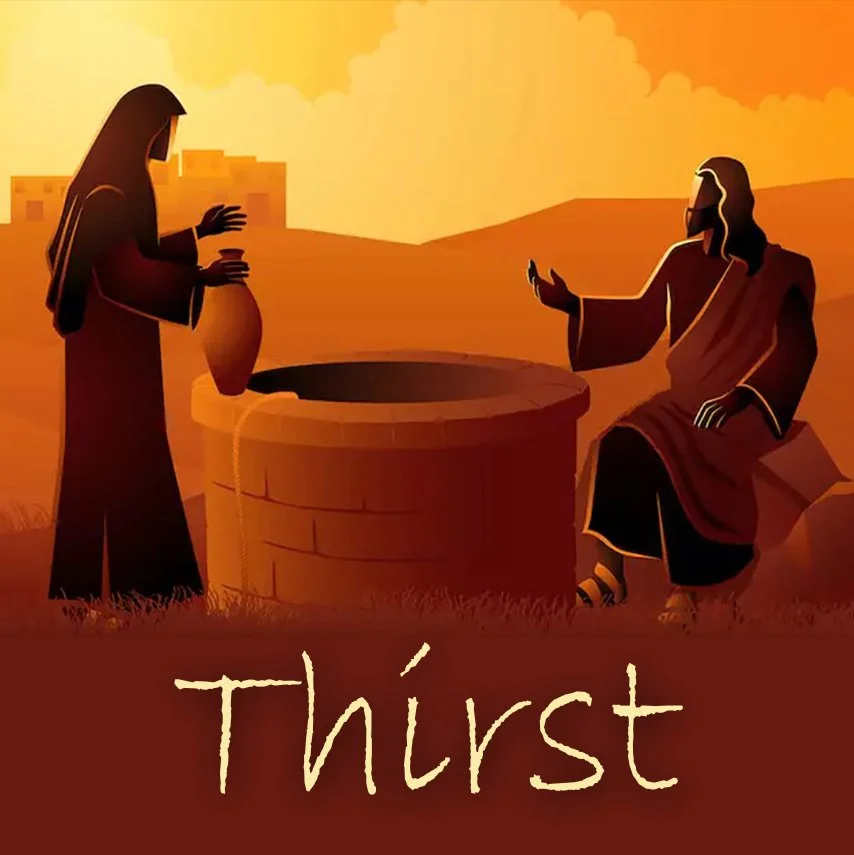
The woman at the well still sees only what is in front of her, a bucket, a deep well, and a weary traveler with nothing to draw with. “Sir, you have no bucket, and the well is deep. Where do you get that living water?” she asks. She cannot yet imagine water that does not come from Jacob’s well, water that becomes “a spring of water gushing up to eternal life.” So she asks for it, not because she understands it, but because she is tired of coming back day after day. “Sir, give me this water, so that I may never be thirsty or have to keep coming here to draw water.”

The woman may not have known who Jesus was or what he could give, but we know all too well, or at least we think we do. And we are more than willing to ask for “water” from the master.

We are quick to pray for health, for security, for comfort, and for more of just about anything we can imagine for ourselves or our loved ones. “Ask anything in my name,” Jesus promises, and so we ask. But his name can become little more than a set of magic words to make our every wish come true, much like the whiny “please” of a child that comes only as an afterthought when their initial demand does not produce the result they wanted.

Like the woman who is just beginning to realize the power of Jesus’ offer, we want a quick fix for all of our problems. We do not want to have to keep coming back to the well every time we get thirsty. We would rather bypass the deeper work and simply eliminate the inconvenience. But the prophet Jeremiah names our condition plainly. “My people have committed two evils,” God says. “They have forsaken me, the fountain of living water, and dug out cisterns for themselves, cracked cisterns that can hold no water” (Jeremiah 2:13). We trade the spring for storage tanks. We settle for what we can control, even when it leaks.

Jesus is not so quick to grant the woman’s desire, even though he is the one who offered the living water in the first place. For him, it is not just about helping her avoid the daily toils of life, such as coming to the well. Jesus wants so much more for her than she could possibly ask or imagine. He wants not simply to quench her thirst for a moment, but to become in her a source that never runs dry.

It would seem that Our Lord finds our desires not too strong, but too weak. We are halfhearted creatures, fooling about with drink and sex and ambition when infinite joy is offered us, like an ignorant child who wants to go on making mud pies in a slum because he cannot imagine what is meant by the offer of a holiday at the sea. We are far too easily pleased.

~ C. S. Lewis, The Weight of Glory

Give Me a Drink

Give Me a Drink

Thirst: Part 2
March 1, 2026

John 4:7-10

 The Samaritan woman asked, “Why do you, a Jewish man, ask for something to drink from me, a Samaritan woman?” (Jews and Samaritans didn’t associate with each other.)

 John 4:9

_______________

We all have those times when God seems distant.  We feel like our prayers are empty and our works of piety are in vain.  We realize that we are empty, that we are nothing, and we would not be surprised in the least if God gave up on us. 

But what if the problem is not that God is too distant, but too close... in fact, way too close for comfort?

By every religious and social custom of his day, Jesus clearly should not have been talking with this woman at a public well in Samaria.  She had three strikes against her that would keep any righteous man far away... she was a Samaritan, she was a woman, and she had a shameful history, even if it was not entirely of her own making. 

Some have speculated that she did not come to the well during normal cooler hours because she didn't want to face the gossip the other women in town must have been speaking about her as they drew water for their "proper" families.

It's interesting how she is so blatantly aware of Jesus' impropriety in asking her for water, and yet Jesus seems entirely unconcerned with her status as a Samaritan or a woman with a past.  Jesus is not worried about being made unclean.  He is not concerned about what others might think.  And he's not even coming with some ulterior motive to convert her to his religious beliefs.

Jesus is simply tired and wants a drink of water.  Period.

I wonder how many times Jesus has come to us, to ask us for a drink or even just to sit down and enjoy a casual conversation, and we responded by pulling away because we knew deep down that we were unworthy of his company. 

What if Jesus wanted to come to us in the form of a homeless person, or an irritating co-worker, or a family member who has hurt us deeply, or a child who won't sit still and be quiet for five minutes.  The faces of Jesus are everywhere, for he says that whenever we care for the "least of these," we have provided for him. 

We don't always recognize his presence, but we can sense the uncomfortable holiness of each encounter stirring deep in our souls, or maybe in the pit of our stomachs, and we want to retreat. 

We know that God already knows us better than we know ourselves, but somehow, we still want to pretend we can keep the worst parts of ourselves a secret.  We're afraid of being exposed.  We like to pretend we're OK, but next to Jesus, we know we are not. 

And if we're truly honest, there are just certain places we don't want to be seen walking around with Jesus.

Just like the woman at the well, we are far more uncomfortable around Jesus' holiness than Jesus is around our sin.

  • What is one place in your ordinary routine that Jesus might show up unexpectedly if you were open to it? 

  • How would you respond?

It's Complicated

It's Complicated

It’s Complicated: Family as a Means of Grace - Part 3
May 18, 2025
John 14:1-4, Romans 12:9-18

My Father’s house has room to spare. If that weren’t the case, would I have told you that I’m going to prepare a place for you?      

John 14:1-7


Love should be shown without pretending. Hate evil, and hold on to what is good.  Love each other like the members of your family. Be the best at showing honor to each other.

Romans 12:9-10

_______________

In our Father’s house, there are many rooms — and together, we are learning how to live as one.

I grew up with a very different understanding of this passage. I was taught the King James Version, which says there are many “mansions.” I never thought to ask how multiple mansions could exist inside one house, but the image I held was highly individualistic and luxurious. Then I went to seminary and studied under Old Testament scholar and archaeologist Dr. Sandra Richter, who introduced us to the ancient 4-room pillared houses of ancient Israel known as the bet’ab — the “Father’s house.” This, it turns out, is the term Jesus uses when describing the place he is preparing.

The bet’ab was not a mansion, nor was it a space of private luxury. It included shared family living spaces, a combined reception room and kitchen, and small  sleeping areas often located on the upper level. In Israel’s patriarchal culture, the oldest living male was the head of the household, which included his sons, their wives, extended relatives, and sometimes servants. Much of the living and cooking took place outdoors, with rooms arranged around a central courtyard. Resources were shared, and everyone contributed to the needs of the household and wider community.

So what does this have to do with Jesus and his promise of heaven?

I’m glad you asked.

For Jesus, salvation is not some escapist dream of heavenly mansions and golden streets. It’s about a communal sense of belonging. In Christ, we are adopted into God's family, and we are given a place in the bet’ab — God’s household. 

But belonging to a household carries responsibilities. Children — biological or adopted — are expected to participate fully in the life of the family. Yes, they receive the blessings and love that come with being part of the family, knowing all their needs will be met. But they are also expected to contribute, to discover and use their gifts for the good of the entire household.

Family life, of course, is complicated. We don’t always get along, and sometimes those closest to us bear the brunt of our worst days. Siblings, in particular, can be highly competitive.

Life teaches us what it means to be part of a family — the human family, God’s family. As Paul writes to the Romans: “Love should be shown without pretending. Hate evil, and hold on to what is good. Love each other like the members of your family. Be the best at showing honor to each other.”

May this be our greatest competition in life: to outdo one another in showing honor and love. In a world that often rewards pride, power, or personal gain, what if we became known for something else entirely — a radical, joyful commitment to building each other up? That’s the kind of family Christ invites us to be.


Christmas at John's

Christmas at John’s

December 22, 2024
John 1:1-5, 14

In the beginning was the Word
    and the Word was with God
    and the Word was God.
The Word was with God in the beginning.
Everything came into being through the Word,
    and without the Word
    nothing came into being.
What came into being
    through the Word was life,
    and the life was the light for all people.
The light shines in the darkness,
    and the darkness doesn’t extinguish the light…

 John 1:1-5

_______________

Of the four gospel writers, John appears to be the poet and artist of the group.  Christmas at his house is no doubt filled with the most creative décor and an elaborate feast.  Technically, like Mark, John doesn’t tell the story of Jesus’ birth at all.  Unlike Mark, however, the beginning of the good news for John is not in Jesus’ active ministry, or in his birth like Luke, or even in his ancestral line like Matthew.  No, the beginning of the good news for John is the beginning of all creation.

The Word was with God and the Word was God and everything that came into being came through the Word… and now John tells us that this very word through which all things were made, has put on flesh and dwells among us. 

In 2010, I tried to wrap my head around what this cosmic truth must have felt like for Mary, and what it means for us as we gaze at the baby in the manger.  Below is the first verse and chorus of the song that came to me:

Here I am, face to face with a faceless God
Gazing deep into the eyes of the all-seeing one

 How can i hold you when I'm wrapped in your arms?
How can i feed the bread of life?
How can this baby have known me in the womb?
How can the angel's words be true?

All of my life, I've tried so hard to believe
In a God so high above, I wondered could you hear me
But now you're here, wrapped in my flesh and bone
And I'm still tryin' O Lord, so hard to believe

For John, it’s not enough that Jesus is Israel’s Messiah or even the Savior of the World.  Jesus is the fullness of the Word that spoke light into the darkness and the darkness cannot overcome it.  Jesus embodies the Word of Life that spoke all of creation into existence.   John takes seriously the words of the Psalmist who writes, “The heavens declare the majesty of God and the skies proclaim the work of God’s hands” (Psalm 19:1). 

Poetry and art exist to express something deeper than what ordinary words can say.  It is the language of the soul.  John portrays Jesus as the language of God’s heart and soul.  The words of the prophets and the angels were not enough for the people to stay in love with God.  Now it’s time for God to speak directly.  But God doesn’t speak in the language of laws or declarations or doctrinal standards. 

No, God speaks the language of love wrapped in flesh… the pinnacle of God’s creation, humanity itself, now showing us what God’s love really means… a love beyond words, a love beyond actions, a love that gives God’s whole self fully for the sake of the world.


 Listen to full sermon here 

Caught Between Truths

Caught Between Truths

November 3, 2024
John 18:33-19:16, Psalm 2

Jesus replied, “My kingdom doesn’t originate from this world. If it did, my guards would fight so that I wouldn’t have been arrested by the Jewish leaders. My kingdom isn’t from here.”

“So you are a king?” Pilate said.

Jesus answered, “You say that I am a king. I was born and came into the world for this reason: to testify to the truth. Whoever accepts the truth listens to my voice.”

“What is truth?” Pilate asked…

… From that moment on, Pilate wanted to release Jesus.

John 18:36-38, 19:12

_______________

Jesus is clear that his kingdom is not of this world and that his primary purpose is to “testify to the truth.”  Pilate responds with the question that has haunted us all for over 2,000 years… “What is truth?”

Here in the 21st century, we are still sitting on the edge of our seats waiting for Jesus’ answer, as though the conversation somehow got cut short.  And in the meantime, we have had more than enough “truth-sayers” trying to fill in the blanks with their own answers to this seemingly impossible question.  As a result, we now live in a culture where truth is so drowned out by lies that we can hardly tell the difference.  When lies are told often enough, they don’t necessarily become facts, but they do create a certain kind of truth that shapes reality.  When enough people believe a lie and act on it, it’s veracity no longer matters.  Real people get hurt, and most often it is the innocent and marginalized that are harmed the most. 

Just a few weeks ago a gunman was arrested in North Carolina over threats of potential harm intended against FEMA workers.  Lies and conspiracies about the government relief organization have run rampant in the aftermath of two disastrous hurricanes and the fact that they are not true doesn’t change the real harm they are causing to relief workers and storm victims in desperate need of help.  Sadly, this is only one of many examples where the truth or lack of truth has become irrelevant and caused great harm to entire groups of people throughout our nation during the current election cycle.

The same reality was true for Jesus.  It didn’t really matter whether he was a king or not, or what kind of kingdom he proclaimed.  It didn’t matter if he actually deserved to die.  For Pilate, and far too often for us, there was a voice far louder than truth.  It was the voice of fear.  The lynch-mob that yelled the loudest got to decide what truth was.  Jesus is guilty… Crucify him!

And in the end, truth surrendered to the fear of the people and quite literally died at the hands of both the mob and the state. 

Jesus says that if his Kingdom were of this world, he would respond with violence as the world does, but instead he chooses not to fight because his Kingdom is not of this world.  How tragic then that his followers across the centuries continue to fight.  We continue to stir up people’s fear with lies and conspiracies for the sake of political power, wealth and security. 

Perhaps the mobs of fearmongers understand Jesus’s truth better than it seems.  The truth of God’s kingdom will not give them the earthly power they desire.  It will call them to surrender and to lay down their lives for the sake of love, even the love of their enemies. 

“What is truth” indeed, that it would call us to sacrifice so much?


Not Alone

Not Alone

September 29, 2024
John 13:34-35, 1 John 4:7-17

“I give you a new commandment: Love each other. Just as I have loved you, so you also must love each other.  This is how everyone will know that you are my disciples, when you love each other.”

 John 13:34-35

_______________

A story is told of a pastor who trudged through the snow to a rustic log cabin where a parishioner lived.  It had been several months since this hermit of a man had stepped foot in the church, though church members often saw him around town.  The man welcomed the pastor in, offered him a hot cup of coffee and they sat down together in the warm glow of a crackling fire. 

Following their brief but cordial greeting, silence settled over the space.  Not an awkward silence, mind you, rather a holy silence, filled with the whispers of the Holy Spirit to both pastor and parishioner alike.  After a while the pastor reached out and, with a set of wrought iron tongs, he pulled a burning ember out of the fire and placed it carefully on the stone hearth.  The light from the tiny wood chip faded and smoke began to rise.  In no time, this little isolated fire had gone out.

The pastor then carefully placed the smoldering ember back into the fire and in an instant, it glowed brighter than before. 

As he stood up to leave, the parishioner finally broke the silence.  “Thanks for the sermon, preacher.  I’ll see you on Sunday.”

Just like the man hidden away in the warmth of his secluded cabin, there comes a point when our isolated embers will burn out.  We are indeed the church scattered as we live out our faith in our everyday, individual lives, and we must be the church gathered, remaining in the Holy Fire of God’s love  expressed through the love of one another in community. 


If God is love, then relationships are the necessary channel through which that love is expressed and known. As those who seek to follow Christ’s example, we cannot pick and choose who we will love based on preference, affection, similar interests, or agreement of opinions.  We must love as Christ loved us.  We must be vulnerable, serve one another, and open our hearts to the stranger. 

John O’Donohue invites us to bless the space that exists between us so that the walls of division may have no place to stand, and that love will bind all of creation together in the heart of God. 

As a popular benediction from the United Methodist Hymnal declares,

Go now in peace to serve God and your neighbor in all that you do. Bear witness to the love of God in this world, so that those to whom love is a stranger will find in you generous friends.

__________

Consider a time when you felt the most lonely or isolated, when you felt like a stranger.  How did you experience God in that season of your life?

What does “community” mean to you?  Where do you most experience authentic community in your life?  Where do you truly belong?


Entwined


Entwined
July 14, 2024
John 15:1-17

As the Father loved me, I too have loved you. Remain in my love.  If you keep my commandments, you will remain in my love, just as I kept my Father’s commandments and remain in his love.  I have said these things to you so that my joy will be in you and your joy will be complete.  This is my commandment: love each other just as I have loved you.  No one has greater love than to give up one’s life for one’s friends. 

 John 15:9-13 (CEB)

_______________

Jesus’ teaching on the vine and the branches is fairly commonplace in the church, and in many ways, the
lesson seems obvious.  A branch that is not connected to the vine will die.  In the same way, we must remain connected to Christ or we will die in a spiritual sense.  Simple as that… or is it?

The problem is that too often we interpret this like we interpret far to many passages of scripture, through the lens of modern American individualism.  So long as “I” remain connected to Jesus, “I” will be ok.  But what if the “you” is plural?  What if it’s not just about each individual and their own private, personal relationship with God, but more about our collective connection to the vine.  After all, Jesus says “you are the branches”, not “the branch” or even “a branch.”  “You” is all of us. 

The thing about a vine is that it is impossible to tell where one branch stops and another begins.  They are entwined together as they grow out of the central vine.  Yes, each branch must be individually connected to the vine, but it is equally true that branches are inextricable from one another and if one is broken or diseased, it must be cut off in order not to hinder the growth of the other healthy branches.  In other words, each branch depends on the health of the others.  We depend on each other.  Christianity can never just be about “me and Jesus.”  The health of our connection to the vine impacts the health of every other branch as theirs impacts our own spiritual healthy.  We are always strong together than we are apart.  A vine with one lone branch can never be healthy or fruitful.  We need every one.

Part of this means that we do not come to church for ourselves.  We do not come to hear a good message, sing our favorite hymns, and go home feeling better about ourselves.  No, we come for one another.  We come not to be served, but to serve.  We come not just to receive, but to give.  We come because we belong to one another, we are part of one another, and we cannot simply choose to disconnect from our fellow branches without also cutting ourselves off from the vine. 

It seems easy to love God, or to love Christ, but other people are not always so lovable.  As Episcopal Priest Sheila McJilton puts it, other people “demand too much of us.  They disagree with us.  They don’t act the way we think they should act.”  Yet, to stay connected with Jesus is also to stay connected with them.  To abide in Christ is also to abide in community with others who may not be very easy to abide with.  Being a Christian is not about what we get out of it.  It is about being part of something bigger than ourselves, committing ourselves to the good of one another, whether we feel like it or not.  “As branches, we connect to Christ until we encircle each other in intricate, interwoven relationships.  In Christ, we grow in love."   


The Wild Goose


The Wild Goose
The Way of the Wild Goose - Part 1
May 19, 2024
Acts 2:1-4, John 3:4-8

Nicodemus asked, “How is it possible for an adult to be born? It’s impossible to enter the mother’s womb for a second time and be born, isn’t it?”

Jesus answered, “I assure you, unless someone is born of water and the Spirit, it’s not possible to enter God’s kingdom.  Whatever is born of the flesh is flesh, and whatever is born of the Spirit is spirit. Don’t be surprised that I said to you, ‘You must be born anew.’  God’s Spirit blows wherever it wishes. You hear its sound, but you don’t know where it comes from or where it is going. It’s the same with everyone who is born of the Spirit.”

John 3:4-8

_______________

Enemy of Apathy

 by John Bell


She sits like a bird, brooding on the waters,
Hovering on the chaos of the world’s first day;

She sighs and she sings, mothering creation,
Waiting to give birth to all the Word will say.

She wings over earth, resting where she wishes,
Lighting close at hand or soaring through the skies;

She nests in the womb, welcoming each wonder,
Nourishing potential hidden to our eyes.

She dances in fire, startling her spectators,
Waking tongues of ecstasy where dumbness reigned;

 She weans and inspires all whose hearts are open,
Nor can she be captured, silenced or restrained.

For she is the Spirit, one with God in essence,
Gifted by the Saviour in eternal love;

She is the key opening the scriptures,
Enemy of apathy and heavenly dove.

From the Iona Community, Wild Goose Publications


The images, symbols, or metaphors for the Holy Spirit are many, (fire, wind, water, breath, dove, etc.) but none can fully capture the mystery that is God’s very presence in us and among us.  For Celtic Christians, the Wild Goose became the dominant image for the wild and untamable wind that blows wherever it wishes.  “You hear the sound of it, but you do not know where it comes from or where it goes” (John 3:8). 

Over the next several weeks we will journey with the Celtic Saints of ancient Ireland and explore what the Wild Goose image has to teach us about the nature of the Holy Spirit in our lives.  In  particular we will look at the presence, the call, the bond and the persistence of the Holy Spirit.  In the end, my prayer is that each of us will deepen our  relationship the Holy Spirit and become more aware of the Spirit’s work and presence in our lives. 

Take a few moments with the poem above and reflect on what images of the Holy Spirit resonate most with you and why?