resurrection

Paying Attention

Paying Attention

Experiencing Resurrection: Part 3
April 26, 2026

John 20:1-18


Jesus said to her, “Woman, why are you crying? Who are you looking for?”

Thinking he was the gardener, she replied, “Sir, if you have carried him away, tell me where you have put him and I will get him.”

Jesus said to her, “Mary.”

She turned and said to him in Aramaic, “Rabbouni” (which means Teacher).

Jesus said to her, “Don’t hold on to me, for I haven’t yet gone up to my Father. Go to my brothers and sisters and tell them, ‘I’m going up to my Father and your Father, to my God and your God.’”

~ John 20:15-17

_______________


I come to the garden alone, while the dew is still on the roses… and he walks with me, and he talks with me,
and he tells me I am his own…

That sweet, beautiful garden. The quiet. The voice.

That wondrous morning began as a day of sorrow, a day of sadness. As I walked to the tomb, my heart was heavy.

I walked slowly, under the cover of darkness. My sandals crunched softly on the gravel path. All else was eerily quiet. The birds had not yet awakened. The sound of the crickets was fading as dawn approached.

I wrapped my cloak more tightly to block out the chill, and I could feel the dew on my feet as I stepped through the patches of grass near the tomb.

When I arrived, the stone had been moved. The tomb was wide open.

I felt it in the pit of my stomach. Something was wrong.

I ran back to the disciples. “You’re not going to believe this. The stone is gone!”

Peter said he wouldn’t believe it until he saw it. He and another disciple ran to the tomb. When they arrived, they looked in and saw the same thing I had.

I couldn’t leave. I needed to know where he was. So I stayed and wept. I didn’t understand. The uncertainty was unbearable.

“Why are you crying?” he asked.

“They have taken away my Lord, and I don’t know wherethey’ve put him.”

I turned to follow their gaze. There was a man standing there. I assumed he was the gardener.

“Woman,” he said, “why are you weeping?”

“I just want to see Jesus.”

Instead, he offered only a single word… “Mary.”

That’s all it took. Just that one word.

He knew me. He saw me. I was no longer alone.

In that instant, everything changed. The grief, the confusion, the aching emptiness… all of it went away.

He didn’t rise with loud thunder or angels singing from the skies. He came with a quiet, comforting whisper… a voice I knew so well… “Mary.”

Before Jesus, my life was wrapped in darkness. I was tormented by darkness that would not let me go. People avoided me. I was feared, shunned, cast aside.  He stepped into my life, right where I was, and cast out every demon with the light of love.  He made me new.  He is still making me new.  And he sent me to share it with everyone.

But in that moment, I was there. I showed up. I stayed. But love would not let me hide. And because I was there, he once again led me into joy.  And the joy we share as we tarry there, none other has ever known.


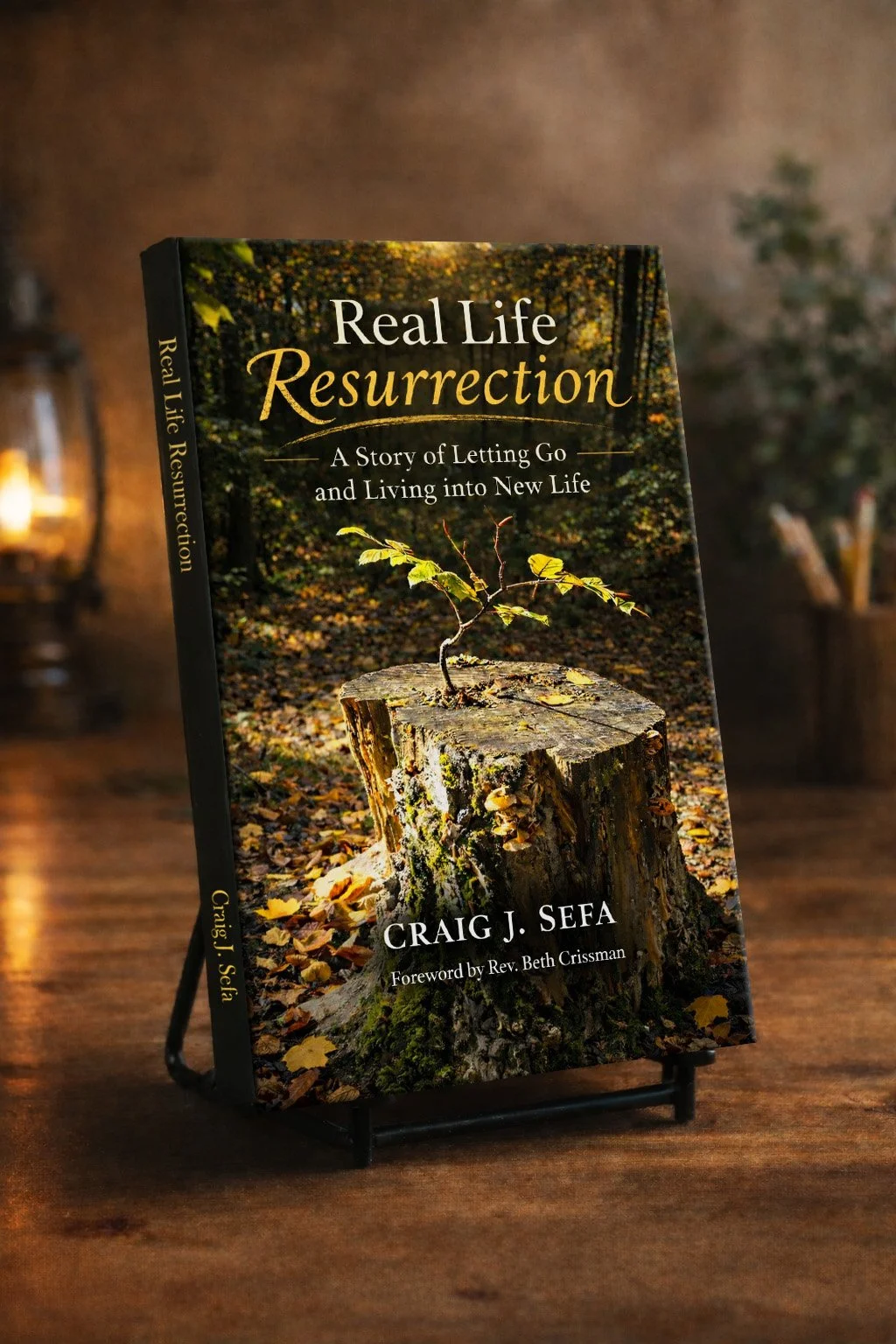
This week’s reflection is an excerpt from my new book, Real Life Resurrection.

For more information, purchase links and study guides, click here.
The Rooster Crows

The Rooster Crows

Experiencing Resurrection: Part 2
April 19, 2026

John 21:4-19

Jesus asked a third time, "Simon son of John, do you love me?" Peter was sad that Jesus asked him a third time, "Do you love me?" He replied, "Lord, you know everything; you know I love you." Jesus said to him, "Feed my sheep."

~ John 21:17


_______________

As the others began cleaning up after the meal, Jesus turned to me.  He looked me dead in the eye, called me by name, and asked “Simon, son of John, do you love me more than these?”

I froze. 

I knew he had no reason to believe that I loved him after what I had done.

With tears welling in my eyes, I told him, “Yes Lord, you know that I love you.” 

I couldn’t have been more sincere, but in my heart, I didn’t really expect him to believe me. 

“Feed my lambs.”

His response was not what I expected. 

It was just like the day he first called me.  He wanted me to take care of his people.  Why me?  How could he trust me with such an enormous task? 

Then he asked again, “Simon, son of John, do you love me?” 

I knew it.  He didn’t really trust me.  I responded more urgently this time, and I couldn’t hold back the tears.  “Yes, Lord, you know I love you.”  And again, he said, “Tend my sheep.”

We just stared at each other for a moment.  Even through the blurriness of my tears I could see the gentleness in his eyes. 

He asked a third time, “Simon, son of John, do you love me?” 

This was harder than anything I could have imagined.  My mind kept reliving those moments in the courtyard the day he died.  “You were with Jesus,” someone said pointing at me.  “No, no I wasn’t.  You must be mistaken.”  Three different people.  Three times I said I didn’t know him.  And now for a third time, Jesus questioned me.  How could I convince him that I loved him when I had denied even knowing him?  How could I ever expect him to trust me again? 

I wasn’t even sure I believed it myself anymore.  Did I really love him?

I just sat there sobbing, knowing my words couldn’t possibly have any meaning to him, but I responded anyway.   My voice cracked with desperation.

“Lord, you know everything, you know I love you.” 

This time my answer felt more like a question. 

Lord, you know me better than I know myself… you tell me, do I love you? I think I do… I want to love you more than anything… but I failed you, I doubted you, I turned my back on you?  You knew I would deny you.  Will I do it again?  I can’t stand the thought of letting you down again. 

He had to know that I was doubting myself more than I had ever doubted him. 

He answered gently, “Feed my sheep.” 

Then he told me to follow him. 

Jesus still wanted me by his side.  I don’t think I’ll ever understand it.  There are many days I don’t feel forgiven, but that’s exactly what he did.  Jesus forgave me. 


This week’s reflection is an excerpt from my new book, Real Life Resurrection.

For more information, purchase links and study guides, click here.

Son of God?

Son of God?

Experiencing Resurrection: Part 1
April 12, 2026

Matthew 27:62-28:15

When the centurion, who stood facing Jesus, saw how he died, he said, “This man was certainly God’s Son.”

 Mark 15:39

_______________  

"Even in Israel I haven't found faith like this."

That's what Jesus told the crowds the day he healed a centurion's servant. But the centurion never wanted to be a model of faith (Luke 7:1-10).  He had no interest in Jesus' religion. If anything, what he did that day was a last-ditch hope, an act of sheer desperation. He wasn't interested in the God of Abraham. He just thought if this teacher they called Jesus could heal others, maybe he might just have a little miracle left over for him and his servant.

And yet. Jesus called it faith.

We don’t know if this was the same centurion we see at the cross but imagine for a moment that it was.  He finds himself passing down the order to crucify that same teacher.  
Seeing Jesus carry the cross beam up the hill stops him in his tracks. He feels a knot growing in his stomach. He had never questioned an order before in his life, but this one just didn't feel right.

He couldn't explain what happened next. The tomb was empty. Dead men don't walk again. So he went along with the cover story. After all, the winners always write history. Surely this would all be forgotten in a few years.

Still, he wondered.

What if this man was the Son of God?

He had pledged his allegiance to Caesar, the one his world called Son of God, savior, prince of peace. But that man, that rabbi, died with more dignity than Caesar had ever shown. Jesus faced the weight of the entire Roman military, unarmed and unafraid. He never resisted his fate, no matter how undeserved. Jesus died like a king. Not the kind of king Rome would ever recognize, but maybe the kind of king we still need today.

We are never told if the centurion becomes a follower of Jesus, but I can imagine him whispering Jesus’ name in the darkness, shaken by all he has seen.  His question lingers for all of us: what would it cost to tell the truth about what we've seen? And what loyalties, comforts, or fears keep us from saying it out loud?

Sometimes our dreams are too small. Like the centurion, it's easy to stay focused only on what's right in front of us.  We tend to live in problem-solving mode, survival mode, just doing our jobs.

We don't serve others so that our church will grow, or so that God will bless us. We serve because that's who we are as followers of Christ. We love because God first loved us.

The centurion didn't know it yet, but he had already encountered the kind of king worth giving everything for and the kind of friend who would give his life for him.

Maybe we have too.


  • Where do you notice competing loyalties in your own life, whether to systems, expectations, or identities, that make it harder to follow Jesus?

  • Reflect on an experience you could not explain but also could not ignore that shifted how you see God.

Resurrection for All

Resurrection for All

Easter Sunday
April 5, 2026

1 Corinthians 15:12-58, Colossians 1:18, Revelation 1:5

He is the head of the body, the church, who is the beginning, the one who is firstborn from among the dead so that he might occupy the first place in everything.

 ~ Colossians 1:18

_______________

We often think of resurrection as a one-time historical event in the life of Jesus. We believe that through the mystery of his death and resurrection we will somehow be welcomed into eternal life. But this individual hope is much smaller than the hope the earliest followers of Jesus carried.

For many first-century Jews who believed in resurrection, it was never imagined as an individual event. Resurrection was communal. It was the hope that God would one day raise all people and finally bring justice to the world. The question was not simply what would happen to one faithful person after death, but whether God’s justice would ultimately prevail for everyone who had suffered under oppression and injustice.

When the apostle Paul proclaimed that Jesus had been raised, some asked, “How can there be resurrection if the dead have not yet been raised?” Paul responded that Christ is the first fruits of those who have died (1 Corinthians 15).    

In other words, Easter is not the end of the story, it is the beginning. Jesus is the firstborn from the dead, the first sign that God’s promised future has already begun to break into the present.

The resurrection is not simply a reward for Jesus’ faithfulness. It is God’s vindication of his life and his way of love.  Resurrection is God’s “yes” to Jesus and God’s “no” to the powers that executed him. Easter reveals something essential about God: the forces of domination, violence, and fear do not have the final word.

Because of this, resurrection is not only something we believe about the past. It reshapes how we live now.

If Easter is God’s “yes” to the way Jesus lived, then those who follow him must learn to live in that same light, refusing the systems of fear and power that once led to his execution.

Resurrection is not only something that happened to Jesus a long time ago.  As Rev. Dr. Mark Sandlin puts it:

Resurrection is what happens every time love refuses to stay buried, every time hope rises up out of places everyone else has given up on, every time a community comes back together after being torn apart, every time justice gets back on its feet after being knocked down again.

Look at the world. Everywhere there’s pain, there’s also someone showing up with compassion. Everywhere there’s despair, there’s someone planting seeds anyway. That’s resurrection! That’s new life breaking through the cracks.

Resurrection isn’t magic. It’s movement. It’s love getting up again and again…

If you want to experience resurrection, you just have to pay attention to the ways love keeps choosing to rise right in front of you.

 Where do you see signs of resurrection breaking through — in your life, in your community, or in the world — and how might God be inviting you to join in that rising love?

Everything [in] between Grief & Hope

Everything [in] between Grief & Hope

Everything [in] between: Part 7
Series based on the Narrative Lectionary & Sanctified Art
April 13, 2025 - Easter Sunday
John 20:11-18, Luke 24:1-12

Very early in the morning on the first day of the week, the women went to the tomb, bringing the fragrant spices they had prepared.  They found the stone rolled away from the tomb,  but when they went in, they didn’t find the body of the Lord Jesus.  They didn’t know what to make of this. Suddenly, two men were standing beside them in gleaming bright clothing.  The women were frightened and bowed their faces toward the ground, but the men said to them, “Why do you look for the living among the dead?  He isn’t here, but has been raised. Remember what he told you while he was still in Galilee,  that the Human One must be handed over to sinners, be crucified, and on the third day rise again.”  Then they remembered his words.  When they returned from the tomb, they reported all these things to the eleven and all the others.  It was Mary Magdalene, Joanna, Mary the mother of James, and the other women with them who told these things to the apostles.  Their words struck the apostles as nonsense, and they didn’t believe the women.  But Peter ran to the tomb. When he bent over to look inside, he saw only the linen cloth. Then he returned home, wondering what had happened.

Luke 24:1-12 (CEB)

_______________

Reflections written by Rev. Jeff Chu

Grief is liminal, not terminal


What makes an ember of hope flare up into a revivifying fire?

Sometimes it’s a memory.

Then they remembered his words, Luke says of the women who had brought burial spices to Jesus’ tomb. It took outside help, in the form of two angels, and it wasn’t instantaneous. First there was terror, because it’s not every day that otherworldly visitors come calling. But then they received a gentle word: Remember.

Sometimes it’s a testimony.

The spark of the women’s story gave Peter just enough hope to get up, run to the tomb, and seek more for himself.

Sometimes neither memory nor testimony will feel sufficient. The cold cloak of grief may still be too thick, as it was for Jesus’ other friends. To them, the women’s story was λῆρος (leros). My Bible translates that Greek word as “an idle tale,” but I think that lacks oomph. Really, it might be better rendered “nonsense” or “the mutterings of the delirious.”

The other apostles’ incredulity feels so relatable to me, especially in the context of our contemporary lives. In a world beset by so much sorrow, so much suffering, and so much heartbreak, a glimmer of good news can have such a hard time breaking my gloom. A glimpse of beauty, a flash of loveliness, can feel like foolishness amidst so much bad news.

This isn’t to say, of course, that it’s wrong to sit with grief. Our grief deserves our attention, because mourning is a bittersweet memento of love. We need not rank our griefs either. Even when it comes to the pettiest, tiniest things, we need to grieve so that we can make room for the better.

There’s the key, though: our grief cannot become our everything. With memory, testimony, and time, we can recognize that grief is liminal, not terminal. And it need not crowd out other truths: that we have loved and been loved. That we are not alone. That there is still hope in the land of the living. 


Weak to Be Strong

Finding-God-At-the-End-of-Your-Rope.jpg


Weak to be Strong
Finding God at the End of Your Rope - Part 7
Easter Sunday, March 31, 2024
Matthew 27:62-28:15, 2 Corinthians 1:3-11


The next day, which was the day after Preparation Day, the chief priests and the Pharisees gathered before Pilate.  They said, “Sir, we remember that while that deceiver was still alive he said, ‘After three days I will arise.’  Therefore, order the grave to be sealed until the third day. Otherwise, his disciples may come and steal the body and tell the people, ‘He’s been raised from the dead.’ This last deception will be worse than the first.”

Matthew 27:62-64

If the authorities were terrified of a dead savior, who they were convinced could not truly have risen from the grave, how is it that a living savior who we believe is alive in us be so easily ignored by the world?  Could it be that a dead Savior held more power over them than a living savior holds over us? 

In Matthew 28, we find the soldiers spreading the lie that they had fallen asleep and that the disciples indeed did steal the body.  What could possibly drive a Roman Soldier to "admit" that he fell asleep on duty, let alone an entire guard unit?  Such failure carried serious consequences, perhaps even death, which is why they depended on bribes from the Sanhedrin to save their own necks.  

Even though Jesus’ enemies did not believe in the resurrection itself, they absolutely believed in the power of the idea of a resurrection, and it brought them to their knees and left them scrambling to cover up the evidence at any cost.  We believe in the resurrection, or at least we say we do, but somehow, we don’t live as if we believe it has any power or meaning.

For the disciples, this truth had the power to turn their very lives upside down… it gave them the boldness to risk everything and defy the very world which held over them the same power of life and death they had held over Jesus.  Almost every one of them was so absolutely confident in the power of the resurrection, that they preached it even in the face of their own executions.  Like Jesus, the disciples were loved by many who believed, but were very much despised, rejected and hated by the world as a whole.  They suffered imprisonment, abuse of every kind, and even death at the hands of both the religious leaders and Rome itself.  But no matter how badly they were treated, they absolutely could not be ignored, because the power of the Risen Christ lived within them?

The power of the resurrection is easily stripped away by familiarity, as if it were just another good story.  But this year, will we allow ourselves to look deeper into our weakness, deeper into the graves in our lives, and tremble with fear and joy that God has overcome the grave.  If Christ is still dead… then we are still dead in our sins… but if Christ is alive, then the Resurrected King is resurrecting us… unraveling the grave-clothes of sin that have held us in the tomb for so long and sending us forth to declare His victory!

The final question for us…

Does the reality of a Risen Savior affect our lives as much as the mere idea of a Risen Savior affected the authorities of Jesus’ day?

When someone looks at you and the way you live out your faith, would they conclude that Christ is alive or dead?  And would they have any reason to believe that it matters?  We may be loved or we may be hated, but if Christ truly lives within us… we cannot be ignored! 

We cannot simply walk away as if it’s just another good story.  In any age… a “dead man walking” demands a response from everyone who hears. 

How do you respond to the Good News that Christ the Lord is Risen Today?  Perhaps with joy, perhaps with fear… but indifference is simply not an option.  As you walk away from the empty tomb this week, what will you do with the Risen Christ?