
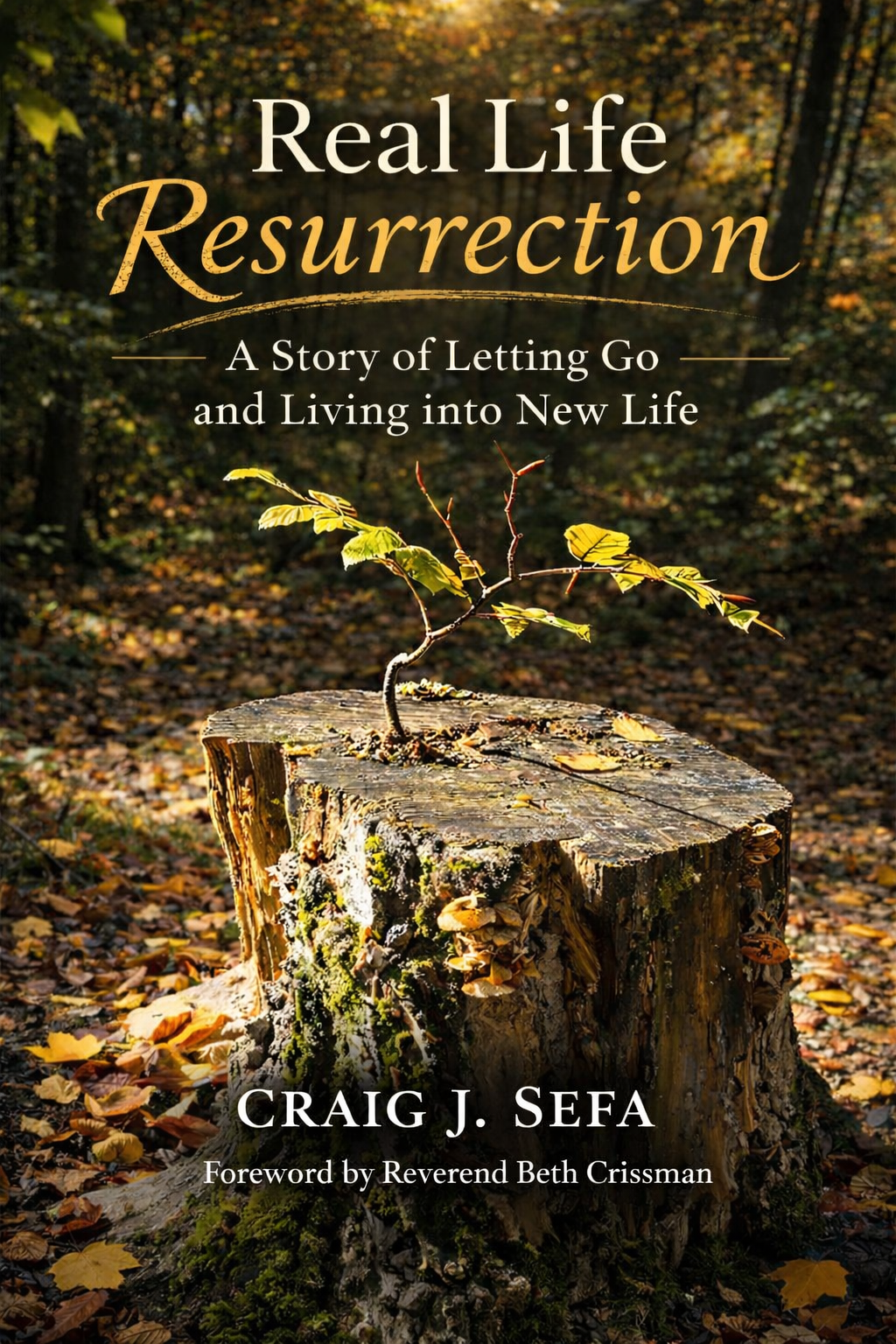
REal Life Resurrection
A Story of Letting Go and Living into New Life
__________
But in fact Christ has been raised from the dead. He’s the first crop of the harvest of those who have died. Since death came through a human being, the resurrection of the dead came through one too. In the same way that everyone dies in Adam, so also everyone will be given life in Christ.
1 Corinthians 15:20-22
Real Life Resurrection is a story of letting go and learning to live again.
This book weaves together two stories of new life.
First, the story of Christ’s resurrection as told through the gospel narratives. Through an Ignatian imaginative reading of Scripture, each resurrection encounter is retold in the first person, from the voices of those who experienced it first hand. Mary in the garden. Thomas in his doubt. Peter by the fire. You are invited not just to observe the resurrection but to step inside it and consider what rising again might mean in your life.
Second, the story of two struggling United Methodist churches in North Carolina that chose to embrace a new beginning through merger. Through my eyes as their pastor, you will witness grief, surrender, uncertainty, and the unexpected hope of a congregation learning to trust God with change. Along the way, you will glimpse my own inner journey of letting go and finding new life. My hope is that these pages awaken you to the quiet seeds of new life already stirring beneath the surface of your own story and give you the courage to nurture them through dry and barren seasons.
Resurrection is not just something to believe in.
It is a reality to be lived.
EXCERPTS FROM INTRODUCTION
“I don't think I've ever heard so many people who claim they believe in the resurrection be so worried about the death of their church.”
Diana Butler Bass made this observation at a gathering of discouraged church leaders during a Q&A with Phyllis Tickle, a prominent voice in the Emerging Church Movement of the early 2000s.
She’s not wrong.
One might be hard pressed to find a church over the past several decades that is not reeling from declining attendance and financial instability. Even many seemingly healthy large churches struggle with revolving doors, losing nearly as many worshipers as they take in. Of course, there are exceptions. Healthy congregations of every size do exist and play a vital role in their communities. But the broader statistics of decline still hold.
There is no single explanation for this phenomenon. Any number of cultural and religious factors are driving people away from their places of worship. Similar symptoms are felt across the religious landscape. It’s not unique to any one denomination, or even Christianity as a whole.
Some may point to secularization, liberalism, atheism, or laziness, among other things, as easy scapegoats, keeping the mirror pointed away from our own theological, social, ethical, and institutional failings. But none of these explanations paint the full picture.
This book is not an analysis of church decline, but it does call us to confront our own fear of death, even institutional death, in contrast to the power of resurrection. While I draw primarily on church stories and scripture, my hope is that these reflections will resonate with anyone who has walked through loss, wrestled with doubt, or feared that all is lost.
As Martha stood grieving the death of her brother Lazarus, Jesus said, “I am the resurrection and the life… do you believe this?” (John 11:25-26). Perhaps he is asking us the same question. Do you, church, believe this?
Regardless of how we understand the nature of Christ’s resurrection, do we truly believe in the creative energy for new life here and now. As theologian Jurgen Moltmann puts it, resurrection is not about “soothing us with the promise of a better world… it’s the energy for a rebirth in this life. Hope doesn’t point to another world. It’s focused on the redemption of this one.”[1]
Jesus didn’t rush to Bethany to save Lazarus from death. He had something much bigger in mind. As we grieve the loss in our own lives and in our churches, it’s easy to feel Mary’s anger rising in us. “Lord, if you had been here, my brother would not have died (John 11:32).”
Jesus never promised a life free from death. Instead, he calls us to a life that overcomes the power and fear of death. Like those who have gone before us, we will all die. Our institutions will die as well. Our congregations and denominations are not eternal. Our buildings will crumble and fall. Our beloved cemeteries will one day be overgrown and forgotten. We all hope the end won’t come in our lifetime, but it will come. Death will come for us all.
But for today, we live to tell the story. We proclaim the great mystery of faith: Christ has died, Christ is risen, Christ will come again.
Death is all around us. So is new life. Our call is not to subvert death or to desperately cling to the nostalgia of our past. Instead, we echo the prophetic voice of hope and new life in a dying world. We scatter seeds even on the soil we think is barren. We trust that springs of living water lie just below the surface, waiting to gush forth and reawaken a dry and thirsty land. And in whatever small ways we are able, we must call that water forth from the rocks so a dying world can drink.
Resurrection has always been the Christian answer to fear, decline, and death. If it is to speak hope into our present moment, we need to first understand what resurrection meant to Jesus and his earliest followers?
About this Book
Resurrection is more than a doctrine to debate; it’s a story that continues to unfold in our lives. That is why this book tells two kinds of resurrection stories. First, the story of Jesus as told through the lens of those who were there, whose stories are recorded in the New Testament. Second, it’s the story of two small churches struggling to stay afloat and how mutual sacrifice and the dream of new life opened the door for real life resurrection among a people who were quickly losing hope.
The odd-numbered chapters can be read independently as a devotional or small group study on the resurrection narratives in scripture. I have included a study guide in the back, which works especially well as a follow-up to Lent and Easter as your group moves toward Pentecost.
Theologians remind us that resurrection is not just about the past, but about God’s ongoing work in creation. But theology only takes us so far. We also need ways to enter these resurrection stories personally. That is why I have retold these resurrection stories in the style of Ignatian prayer, which invites us not only to read the scriptures, but to step into the story with our imagination.[2]
In some ways, the resurrection stories in this book are fictional accounts of what might have been going on in the hearts and minds of those who first encountered the risen Christ. At the same time, they are more than mere fiction. While they may not reflect literal history, they invite us into deeper truths of the human experience, particularly as it relates to comfort and grief, hope and despair, life and death…
…The alternating chapters tell the ongoing story of merging two struggling United Methodist Congregations in a small North Carolina town. To align with the story of these congregations, the first-person narratives of Jesus are not always presented in the order one might expect. Life is rarely that tidy. Every resurrection story in the gospels, for example, begins with Mary in the garden, and rightfully so. She stayed with Jesus until the end, and she was the first to return after the Sabbath. Her story begins with grief.
My resurrection story with these two churches, however, began in a different place. While I’m sure there was significant grief for some members of these congregations, my own experience began with questioning and doubt. It began with the feeling that I had failed, that there was nothing I could do to prevent disaster. It began by fighting against any sign of hope that may have been there, by feeling utterly alone, and thinking all was lost, both for me and my congregations.
That is why I begin this story not in the garden with Mary, but in the locked room with Thomas. His encounter with the risen Christ resonates deeply with my own questioning and cynicism. He was the only one bold enough to ask the hard questions, to wrestle honestly with the doubt every one of them must have felt, and to find not the judgment of history, but a word of peace and grace from his risen Lord.
Like Thomas, my experience of resurrection hope through these two churches did not begin at the garden tomb. I was not there the night Jesus first appeared to the disciples. In real life, resurrection often comes to us in pieces. We rarely know the whole story at the start. There are often questions, and sometimes those who came before us may try to shame us for asking them.
Each resurrection story begins in a different place: Mary’s with grief and longing, Peter’s with guilt and shame, and Judas never experienced the resurrection at all because he gave up too soon. Likewise, each of our stories begins in a different place. That is why I begin with Thomas; not because his story is any more important, but because it was the door through which I first entered into resurrection hope with my congregations. No matter where we begin, the hope of new life keeps drawing us together toward the same promise of new life.
As you read these stories of resurrection and new life, you will find that they are not pie in the sky, all will work out, kind of stories. We often forget that resurrection does not come without the cross. New life does not avoid the reality of suffering and death. Every good outcome first requires sacrifice and making the hard choices as Jesus did that night in Gethsemane.
Yes, resurrection is a promise for all. But first we must take up our cross and follow him. We must enter into his sufferings, that we might truly know the power of resurrection in our lives.
The story that follows may not be your story, but I believe that there are barren places in your life where God desires to plant the seeds of hope and resurrection. I believe there are times when you have felt all was lost, but God was not finished yet. Resurrection is not a one-time event that happened over two-thousand years ago. Resurrection is the ongoing work of God in our lives and in our world. The Spirit invites us into this work of preparing hearts and lives for healing, restoration, and new life.
I offer two prayers for you as you enter this story. First, may you enter deeply into the places of darkness and despair in your own life and discover the seeds of resurrection sprouting just below the surface. Second, may you plant the seeds of hope in the barren soil around you, in your churches, in your community, in your relationships – wherever God has placed you, because the work of resurrection is not yet finished, and God is calling you to prepare for the harvest.
__________
[1] Jürgen Moltmann, Jesus Christ for Today’s World (London: SCM Press, 1994).
[2] For a deeper dive into St. Ignatius and his rich prayer practices including imaginative prayer, the daily examen, and other ways of encountering God’s presence in our daily lives, check out www.ignatianspirituality.com.
For more reflections and audio sermons, subscribe to my blog.