
belonging

Freedom to Belong

Freedom to Grow

Freedom: Part 4
July 26, 2026

Galatians 4:1-5:1


Because you are sons and daughters, God sent the Spirit of his Son into our hearts, crying, “Abba, Father!” Therefore, you are no longer a slave but a son or daughter, and if you are his child, then you are also an heir through God.

~ Galatians 4:6-7

_______________

Craig J. Sefa Freedom to Belong

In Galatians 4, Paul makes a radical theological move that is often misunderstood. He boldly declares that God sent the Spirit into the hearts of Gentiles so they too may cry “Abba, Father” and know themselves as children of God.

The tragedy is that Christians have sometimes used these words to claim their own status over and against the Jews, identifying themselves as the “new Israel.” It is no wonder some Christians today worry about being culturally replaced by other growing religious and ethnic groups. Instead of doing unto others as we would have them do unto us, we worry that others may do to us what we have done to others.

But Paul wasn’t talking about replacement. His claim is even more radical. He was not saying that Gentiles replaced the Jews as God’s children. He was saying that neither Jews nor Gentiles have a “biological” or exclusive claim on God’s household. Both are adopted into the same family by grace.

In 1797, Isabella Baumfree was born into slavery in New York. At nine years old, she was sold for the same price as a flock of sheep and taught that she “belonged” to a human family, not as a child, but as property. When her enslaver broke his promise of freedom, she walked away. When her son Peter was illegally sold to Alabama, she became the first black woman to win a lawsuit against a white man.

In 1843, she felt called by God to travel and proclaim the freedom of the Gospel. She took the name Sojourner Truth, a traveler who deeply understood the truth of who she was. She spent her life advocating for abolition and women’s rights because she understood Paul’s radical claim that whether slave or free, woman or man, every person ultimately belongs to God alone. Her identity in Christ was truer than what the law or the custom said about her.

Later in the chapter, Paul wonders why this message has made him an enemy of the people who once welcomed him. There is always a cost when we include “the wrong people.” Many of God’s beloved children still struggle for the recognition of their spiritual inheritance.

As followers of Christ, none of us can claim a greater birthright than anyone else. We are all adopted. We are all heirs. And we all belong.


Practice: This week, say it out loud.

Find one moment to tell someone, a family member, a friend, even a stranger, that they belong. Not that they are welcome if they meet certain conditions. Just that they belong, full stop. Notice what it costs you to say it and what it gives them to hear it.


_______________
Freedom to Be You

Freedom to Be You

Freedom: Part 1
July 5, 2026

Galatians 1:6-9, 2:11-3:5


But when Cephas came to Antioch, I opposed him to his face, because he was wrong.  He had been eating with the Gentiles before certain people came from James. But when they came, he began to draw back and separate himself, because he was afraid of the circumcision faction.

~ Galatians 2:11-12

Craig J. Sefa Freedom to Be You

_______________

As we honor the 250th anniversary of our nation this weekend, we hold space for both joyful celebration and the heaviness of lament.  We are a nation built on many freedoms, not the least of which is the freedom of religion, and at the same time, we have not lived up to that promise for all people.  Over the next five weeks, we’re going to wrestle with Paul’s letter to the Galatians, a church where they were having their own arguments about what freedom meant, and who was included.

The Galatians were mostly Gentile Christians with no Jewish background and no connection to Jewish tradition or identity markers such as circumcision, dietary laws, or festivals.  They responded to Paul’s message of grace through Christ and the Spirit was clearly at work among them. 

After Paul left, however, other teachers came and told them that faith in Christ was not enough.  They must conform their way of life to align with Jewish identity.  Some church leaders including Peter and Barnabas, who had shared openly in Chrisitan hospitality with the Gentile believers, were now pulling away for fear of their reputation among their stricter traditionalist colleagues. 

It is not hard to see the parallels to our own day.  Various segments of the larger Christian church continue to vie for power and control over who can rightly be considered a Christian.  Even worse, many have become so entrenched with contemporary political ideologies and partisan voting blocs that there is hardly a noticeable distinction between being a good Christian and being what in their opinion is a good American.  By making America look and sound more “Christian”, at least on the surface, it becomes easier to justify their place of privilege and dominant influence overthe larger culture.  But often this results in the public form of Christianity without the substance, in appearance over faith, and in conformity over freedom.

In 1636, Puritan minister Roger Williams was banished from the Massachusetts Bay Colony for sedition and heresy because he declared that civil authorities should not coerce conformity to any faith, including Christianity.  Rather, faith should always be a matter of conscience, freely chosen and practiced by each individual without compulsion.  Soon after, he founded Providence, Rhode Island as a sanctuary for Baptists, Quakers, Jews, Huguenots, and any other group who had been excluded by the dominant religious culture.

Though I have not suffered nearly the persecution Williams experienced, I have found myself “banished” from many churches and Christian groups.  I have regularly been told I am “not really be a Christian” because I do not align with certain political agendas that I find to be at odds with the teachings of Jesus. 

Regardless of where we find ourselves in the polarized climate of our time, Paul’s challenge remains firm.  To make any cultural, religious, or political marker a condition for being part of the body of Christ is a false gospel.  Full stop. 

God has already chosen who is welcome at the table, and no one is excluded.


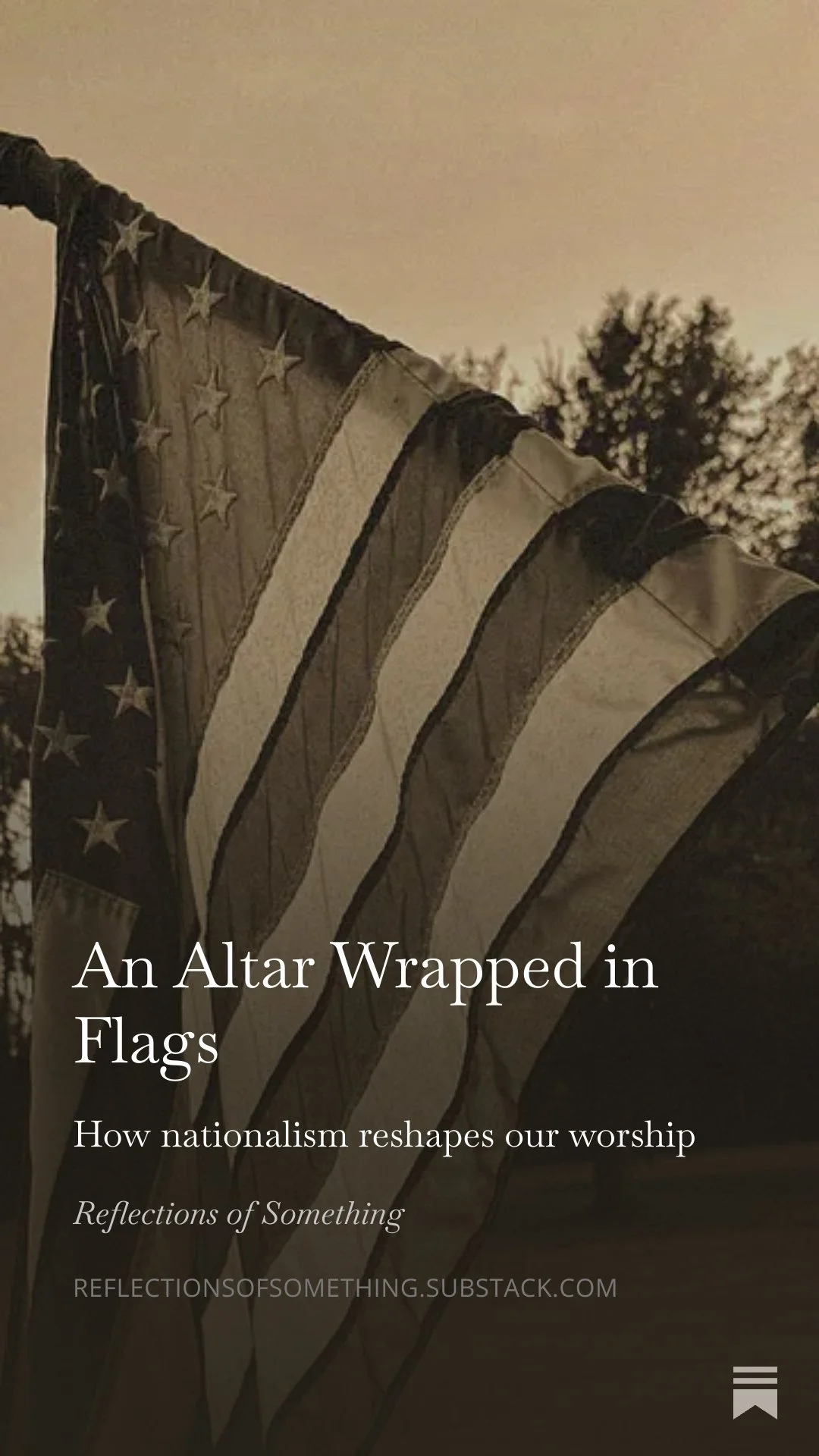
For my personal reflections on the 4th of july this year and the ongoing tension between faith and nationalism, check out my substack post here: An Altar Wrapped in Flags.

#BeUMC - I Belong, You Belong, We Belong

I Belong, You Belong, We Belong

#BeUMC - Part 4

Sunday, July 16 , 2023
1 Corinthians 12:12-20

John replied, “Master, we saw someone throwing demons out in your name, and we tried to stop him because he isn’t in our group of followers.” But Jesus replied, “Don’t stop him, because whoever isn’t against you is for you.”

Luke 9:49-50

This week’s sermon, “I Belong, You Belong, We Belong” comes to us from special guest Rev. Katie Lineberger. Listen here…

Rev. Katie Lineberger I Belong, You Belong, We Belong

___________________


From “Catholic Spirit: Sermon 39” - John Wesley

Though we cannot think alike, may we not love alike? May we not be of one heart, though we are not of one opinion? Without all doubt, we may. Herein all the children of God may unite, notwithstanding these smaller differences. (¶4)

Hold you fast that which you believe is most acceptable to God, and I will do the same. I believe the Episcopal form of church government to be scriptural and apostolical. If you think the Presbyterian or Independent is better, think so still, and act accordingly. I believe infants ought to be baptized; and that this may be done either by dipping or sprinkling. If you are otherwise persuaded, be so still, and follow your own persuasion. … I have no desire to dispute with you one moment upon any of the preceding heads. Let all these smaller points stand aside. Let them never come into sight. “If thine heart is as my heart,” if thou lovest God and all [hu}mankind, I ask no more: “give me thine hand.” (§II, ¶2)


We are social creatures, designed to live in community. We celebrate family bonds, community Oes, and even feel a kinship with fellow fans of our favorite football team. Sometimes, however, our ideas about belonging are corrupted and we begin to draw defined circles too closely. When we view the “other” as one of “them,” we have entered into dangerous territory. Jesus is quick to correct his disciples when they begin to talk about “us.” Jesus modeled the ways we should be more accepting of the beautiful diversity intrinsic in the people of God.

As United Methodists, our inclusiveness requires more than simply welcoming people in worship on Sundays.

We are a people who seek justice.

But let justice roll down like waters, and righteousness like an ever-flowing stream

Amos 5:24

Scriptural holiness entails more than personal piety;   love of God is always linked with love of neighbor, a passion for justice and renewal in the life of the world.  (Book of Discipline, ¶102.1—Our Doctrinal Heritage)


We are a resilient people.

We are experiencing all kinds of trouble, but we aren’t crushed. We are confused, but we aren’t depressed. We are harassed, but we aren’t abandoned. We are knocked down, but we aren’t knocked out.

2 Corinthians 4:8-9

It is easy to feel disheartened in our world. A global pandemic, racial injustice, climate change, economic worries, political divisiveness, family issues, and so much more threaten to steal our joy every day. Yet as people of God, we are people of hope, a hope that gives us strength to rebound even from the most difficult of circumstances. Our faith makes us resilient.


We are a welcoming people.

Keep loving each other like family. Don’t neglect to open up your homes to guests, because by doing this some have been hosts to angels without knowing it. Remember prisoners as if you were in prison with them, and people who are mistreated as if you were in their place.

Hebrews 13:1-3

Being a welcoming person of God entails more than inviting people into spaces where we feel most comfortable. Christ also compels us out into the world, to meet people wherever they are, and to serve as a welcoming presence to others.

 __________
- excerpts from #BeUMC Study Guide

You can download the complete discussion guide at https://www.umc.org/en/who-we-are/our-people/beumc