
hope

A Dragon for Christmas

A Dragon for Christmas

Christmas Letters: Part 5
December 28, 2025

Revelation 12:1-5

Then a great sign appeared in heaven: a woman clothed with the sun, with the moon under her feet and a crown of twelve stars on her head.  She was pregnant, and she cried out because she was in labor, in pain from giving birth.  Then another sign appeared in heaven: it was a great fiery red dragon, with seven heads and ten horns, and seven royal crowns on his heads.  His tail swept down a third of heaven’s stars and threw them to the earth. The dragon stood in front of the woman who was about to give birth so that when she gave birth, he might devour her child.  She gave birth to a son, a male child who is to rule all the nations with an iron rod. Her child was snatched up to God and his throne.  Then the woman fled into the desert, where God has prepared a place for her. There she will be taken care of for one thousand two hundred sixty days.

~ Revelation 12:1-6

_______________

Revelation is probably the last place we’d look for a Christmas story, but the truth is that Christmas, Easter, and the entire story of Creation is all wrapped up in this mysterious vision.  John wasn’t predicting future events.  He was encouraging a persecuted church and proclaiming the gospel in language that Rome would not understand.  That’s why he uses images, symbols and metaphors that would have been recognized by his Jewish audience.

For example, the woman in Revelation 12 is clothed with the sun, with the moon under her feet, and crowned with 12 stars.  Let’s break that down.

  • The sun’s brightness points to God..

  • Israel’s worship calendar is based on the lunar cycle, so this woman is at the center of Israel’s worship.

  • The 12 stars call back to the 12 tribes of Israel, just like in Joseph’s dream in Genesis. 

John is describing God in feminine terms because the focus is on God giving birth – to creation, to Israel, to Jesus, and to the church.  (For more feminine images of God in scripture, check out Hosea 11:3-4, 13:8, Deuteronomy 32:11-12, 18, Isaiah 66:13, Matthew 23:37, Luke 13:34, to name a few).    

The dragon represents Satan, seeking to undermine God’s redemptive work in the world.  That’s why he waits to devour the Christ child.  Think about this in the context of Jesus’ life.  Herod seeks to kill the child before he can become a threat.  Satan tempts Jesus in the wilderness to derail his ministry before it begins.  And in the end, Jesus is defeated by death on the cross.  The dragon has won.

But John tells us that the child was taken up to God in heaven.  Sound familiar?  Resurrection and ascension.  Death was not the end.  And so, the dragon continues to seek out God’s children wherever they may be found, attacking the church to this day. 

In Revelation, John declares to the church that God has taken up residence in Satan’s domain, here in our fallen world, and that no matter how bad things get, God will always have the final victory. 

We may not have wanted a dragon for Christmas, but do not fear.  Christ has already won.


Where do you see signs of victory breaking through the darkness in your life or in our world today?
A Promising Future

A Promising Future

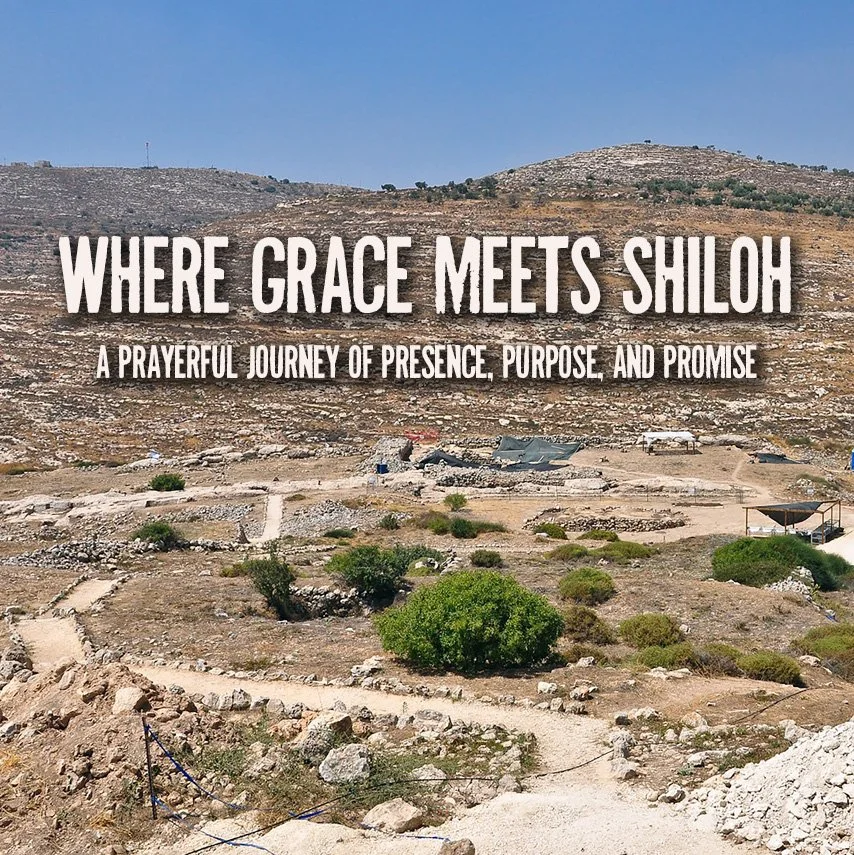
Where Grace Meets Shiloh: Part 4
September 7, 2025

1 Samuel 3:1-21, 1 Samuel 7:3-17

So, Samuel grew up, and the Lord was with him, not allowing any of his words to fail. All Israel from Dan to Beersheba knew that Samuel was trustworthy as the Lord’s prophet. The Lord continued to appear at Shiloh because the Lord revealed himself to Samuel at Shiloh through the Lord’s own word.

~  1 Samuel 3:19-21 (CEB)

_______________

Samuel grew up in Eli’s household as a servant of Lord’s tabernacle.  In some ways, we might say he grew up in church, literally.  He became comfortable around the holy things and learned early on to appreciate their significance.

He also had a front row seat to corruption in the house of God.  He saw Eli’s sons taking advantage of the offerings and even abusing the women who served at the tent of meeting.  Samuel knew both the best and worst of religion firsthand. 

The story in chapter 3 is familiar: God calling to a young boy in the night and giving him a vision for Israel.  Samuel did not recognize God’s voice at first, but Eli taught him how to respond and listen. 

Unfortunately for Eli, God’s word to Samuel meant bad news for his family.  The corruption of Eli’s sons and Eli’s unwillingness to confront it had reached its limit.  Their priestly service would end, and justice would be restored.

To Eli’s credit, he accepted God’s judgment, even when it came through a child.  Samuel grew to be a great prophet, trusted by the people. 

We often hear this story in individualistic terms: a young boy hearing God’s call to ministry.  This is the way we often hear it at ordinations alongside the hymn, “Here, I Am Lord.”

While there is nothing wrong with that reading, I am struck this week by what this text says to us as a community.  The tabernacle was not a church in our modern sense, yet it shared a similar role as a center of worship, and was not immune to corruption, even within its own leadership.  In every generation, God’s people have wrestled with the tension between the holiness we are called to and the reality of our brokenness.

But here is where I believe it also points to a promising future.  Despite all the faults of the tabernacle, or the church, God continues to speak.  Just as God spoke to Samuel, the Spirit still raises up leaders to call God’s people back to their holy purpose.  Chapter 3 ends with the hopeful reminder that the Lord continued to appear at Shiloh because the Lord had revealed himself there to Samuel, and Samuel remained faithful to the word he had been given.

To whatever degree we are faithful with the word entrusted to us, this church, and the church throughout the world, can still bear witness to God’s faithfulness, even when we have been unfaithful.


For Further Reflection: 

  • How have you heard God’s word spoken to you through the church?

  • What is yours to do in helping the church live faithfully?

Everything [in] between Grief & Hope

Everything [in] between Grief & Hope

Everything [in] between: Part 7
Series based on the Narrative Lectionary & Sanctified Art
April 13, 2025 - Easter Sunday
John 20:11-18, Luke 24:1-12

Very early in the morning on the first day of the week, the women went to the tomb, bringing the fragrant spices they had prepared.  They found the stone rolled away from the tomb,  but when they went in, they didn’t find the body of the Lord Jesus.  They didn’t know what to make of this. Suddenly, two men were standing beside them in gleaming bright clothing.  The women were frightened and bowed their faces toward the ground, but the men said to them, “Why do you look for the living among the dead?  He isn’t here, but has been raised. Remember what he told you while he was still in Galilee,  that the Human One must be handed over to sinners, be crucified, and on the third day rise again.”  Then they remembered his words.  When they returned from the tomb, they reported all these things to the eleven and all the others.  It was Mary Magdalene, Joanna, Mary the mother of James, and the other women with them who told these things to the apostles.  Their words struck the apostles as nonsense, and they didn’t believe the women.  But Peter ran to the tomb. When he bent over to look inside, he saw only the linen cloth. Then he returned home, wondering what had happened.

Luke 24:1-12 (CEB)

_______________

Reflections written by Rev. Jeff Chu

Grief is liminal, not terminal


What makes an ember of hope flare up into a revivifying fire?

Sometimes it’s a memory.

Then they remembered his words, Luke says of the women who had brought burial spices to Jesus’ tomb. It took outside help, in the form of two angels, and it wasn’t instantaneous. First there was terror, because it’s not every day that otherworldly visitors come calling. But then they received a gentle word: Remember.

Sometimes it’s a testimony.

The spark of the women’s story gave Peter just enough hope to get up, run to the tomb, and seek more for himself.

Sometimes neither memory nor testimony will feel sufficient. The cold cloak of grief may still be too thick, as it was for Jesus’ other friends. To them, the women’s story was λῆρος (leros). My Bible translates that Greek word as “an idle tale,” but I think that lacks oomph. Really, it might be better rendered “nonsense” or “the mutterings of the delirious.”

The other apostles’ incredulity feels so relatable to me, especially in the context of our contemporary lives. In a world beset by so much sorrow, so much suffering, and so much heartbreak, a glimmer of good news can have such a hard time breaking my gloom. A glimpse of beauty, a flash of loveliness, can feel like foolishness amidst so much bad news.

This isn’t to say, of course, that it’s wrong to sit with grief. Our grief deserves our attention, because mourning is a bittersweet memento of love. We need not rank our griefs either. Even when it comes to the pettiest, tiniest things, we need to grieve so that we can make room for the better.

There’s the key, though: our grief cannot become our everything. With memory, testimony, and time, we can recognize that grief is liminal, not terminal. And it need not crowd out other truths: that we have loved and been loved. That we are not alone. That there is still hope in the land of the living. 


Investing in Hope


Investing in Hope
A God Who Weeps - Part 4
Sunday, September 25, 2022
Jeremiah 32:1-3, 6-15

“The Lord of heavenly forces, the God of Israel, proclaims: Take these documents—this sealed deed of purchase along with the unsealed one—and put them into a clay container so they will last a long time. The Lord of heavenly forces, the God of Israel, proclaims: Houses, fields, and vineyards will again be bought in this land.”

Jeremiah 32:14-15 (CEB)

Listen to this week’s sermon here:

____________________

One of the biggest factors that separates those trapped in generations upon generations of poverty and those who seem to quickly climb to the top of the economic ladder is the difference in real-estate.  Real estate offers what economists call “generational wealth” because unlike cash, property generally maintains and most often increases in value from generation to generation.  Whether or not we personally have wealth invested  in property, it is easy to see the significant role real estate plays in our economy, especially among the richest and most elite. 

The three keys to good real estate investments, however, as any realtor will tell you, are “location, location, location.”  Purchasing land in an up and coming development on the outskirts of a booming city or town is a smart move.  Purchasing in a place with no prospect for growth, or even the strong possibility of decline or destruction, on the other hand, is not smart.  How many times have we seen bad locations where restaurant after restaurant moves into a building and nobody can make a go of it?  Some locations will simply never be successful without radical change in the larger community. 

Such is the case in a war torn land, especially when the war is still in progress and the property will soon be taken over by the occupying government .  This was the state in which Israel found herself in Jeremiah’s day, as the Babylonians continued moving in more and more troops and taking more and more Israelites into captivity and exile never to return. 

Let’s just say that such a place is not a sellers market.  Who wants to buy property that will be razed by an enemy army and evacuated within the year?  Well, apparently there is one person.  Jeremiah.  That’s exactly what he does when he buys the field in Anathoth from his cousin.  One wonders about the character of this cousin who appears to be trying to rip off Jeremiah and get out with as much as he can manage before Babylon moves in and ruins the neighborhood.  Talk about decimating property values.

Jeremiah knows he may never see this property again.  He may never build a home on it.  He may never plant a vineyard or even a garden.  His children and grandchildren may never even know the land existed.  Nevertheless, Jeremiah buys a field in his war torn homeland right before the end.  Why? 

Because God said his people would one day return.  This wasn’t just an investment in real estate.  It was an investment in hope.  It was a deed signed openly in public as a declaration that their exile would not last forever.  Even if nobody from his generation ever saw their beloved homeland again, God would bring God’s children back, and that was a future worth investing in.

How are you investing in hope?


Blessings in the Wilderness - Week 1: Hope

Blessings in the Wilderness - Week 1: Hope

We don't typically seek out the wilderness moments or seasons in our lives, but the hard truth is that the wilderness will always find us. What we may not realize is that this is not necessarily a bad thing. The path to God almost always leads us through the wilderness and God is with us on the journey.

As we enter into this Lenten season, I invite you to join me as we look for the many blessings springing up in the desert and bringing us new life even in the wilderness…

A Long Way From Home

A Long Way From Home

…Jesus wasn't born in a bubble of tinsel and shining lights. He came as a light into darkness, hope into despair, peace into chaos, joy into suffering and love to overcome the hatred and violence of the world, but to truly know Christ, we must first learn to sit with the reality of violence and suffering in our world. Like Job, we can’t go home just yet…